

PLC, which stands for Programmable Logic Controllers, is used to help automate and coordinate manufacturing machinery, ensuring operations run smoothly with minimal human intervention.
These components come in various types and configurations to suit different operational requirements, from compact units controlling a single machine to fully integrated systems managing entire production facilities.
With the right PLC control system in place, businesses, including those in food manufacturing, can improve productivity, enhance precision, reduce downtime, and scale operations efficiently.
What is a PLC?
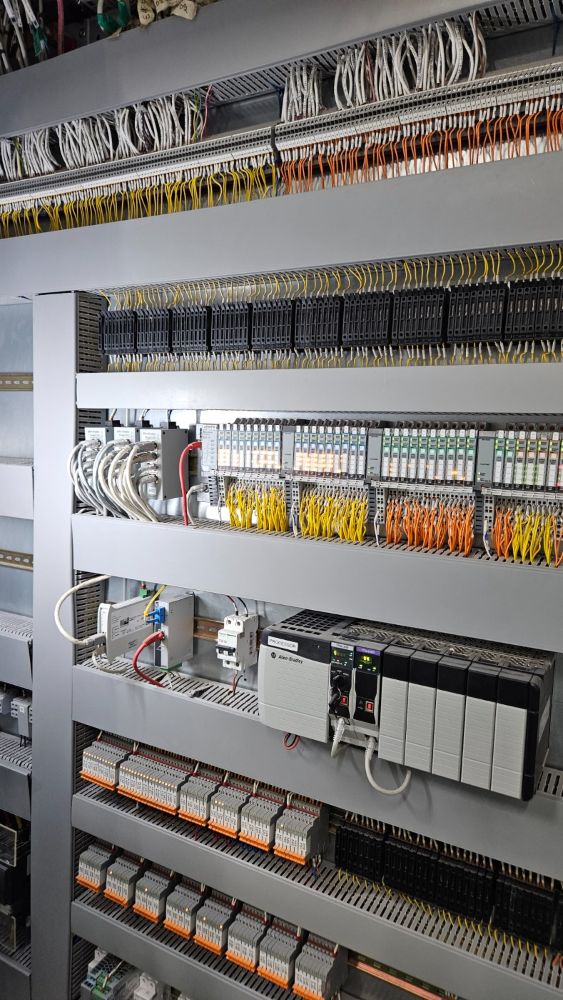
A PLC is a specialised industrial computer designed to control and monitor machinery through customised programming. Unlike standard computers, PLCs are built specifically for factory environments and are equipped with multiple inputs and outputs (I/O) that allow them to communicate directly with equipment on the plant floor.
What Is a PLC’s Role in Manufacturing?
As the manufacturing industry continues to evolve, PLCs serve as the foundation of smart factory environments, enabling advanced automation, process optimisation, and seamless system integration across the production floor. They help with:
- Data Acquisition: PLCs continuously gather and process data from connected sensors and equipment, which means they help in real-time monitoring, analytics, and faster decision-making.
- Interoperability: With support for multiple industrial communication protocols, PLCs allow different machines, control systems, and software platforms to communicate smoothly within a unified network.
- Scalability: Modular PLC architectures make it easy to expand or modify systems as production demands change, ensuring long-term flexibility and adaptability.
What are PLCs Used For?
Some of the primary applications of PLCs include:
- Food and Beverage Production: Food manufacturing plants depend on PLCs for processes such as mixing and sterilisation, batch control/recipe management, automated CIP (clean-in-place) cycles, and conveying speeds on packaging lines. PLCs ensure consistent product quality while adhering to strict regulatory standards.
- Energy and Utilities: PLCs are critical in power generation and utility management, controlling turbine operations, electrical grid switching, and environmental monitoring systems. Their rugged construction enables reliable performance under demanding industrial conditions, while continuous data output supports regulatory compliance and real-time operational decision-making.
- Data Centres and Mission-Critical Facilities: Modern data centres rely on PLC-based systems to automate critical power management. Their ability to coordinate large numbers of I/O points simultaneously ensures that critical systems respond instantly to changing conditions, minimising the risk of failure across interdependent infrastructure.
How Does a PLC Work?
This is what a PLC does in your manufacturing line:
Inputs
- The PLC gathers information from the plant floor.
- It monitors connected devices such as sensors, switches, and machines.
- These input signals provide real-time data about operating conditions.
Program Execution
- The PLC evaluates incoming data against the programmed logic stored in its memory.
- It processes “if-then” conditions to determine the correct response.
- Decisions are made based on predefined rules created by engineers.
Outputs
- The PLC sends commands to connected output devices.
- It updates actuators, motors, valves, alarms, or other machinery accordingly.
Benefits of Using PLC in Manufacturing
Some of the advantages of using PLC include the following:
1. Advanced Process Control and Automation
Functioning as the central “brain” of industrial operations, PLCs automatically respond to system conditions, such as opening a valve to reduce pressure or turning motors on/off to run conveyors. They manage complex actions like adjusting temperatures, displaying alarms on HMIs, and coordinating multiple devices simultaneously.
In high-density I/O environments, a single PLC can control thousands of inputs and outputs, integrate robotic equipment, and manage safety interlocks across production zones.
2. Flexibility and Multi-Vendor Integration
Modern PLC systems support integration of multiple brands, allowing facilities to leverage the strengths of different controllers for specific applications.
3. Data Collection and Monitoring
PLCs gather operational data from connected inputs and machinery, enabling SCADA and machine monitoring systems to visualise production trends, OEE metrics, alarms, and batch status. Centralised monitoring allows operators to identify inefficiencies, coordinate schedules, and respond to equipment issues before they impact throughput.
4. Improved Decision-Making and Maintenance
PLCs serve as the foundational data source for IIoT applications and machine learning algorithms. Visualisation of PLC-collected data allows managers and operators to make informed, data-driven decisions.
Additionally, immediate alarm notifications from PLCs enable faster diagnosis and corrective actions, reducing downtime and operational costs. Collected production data can be analysed to predict maintenance needs, estimate remaining useful equipment life, and optimise quality control.
5. Future-Proofing Operations
A well-designed PLC infrastructure supports ongoing manufacturing innovation by accommodating new connectivity, communication protocols, and advanced technologies without disrupting production. This ensures long-term scalability, adaptability, and alignment with smart manufacturing goals.
Engineering the “Brain” of Your Pneumatic System
For food and beverage manufacturers, a well-designed PLC system ensures the smooth operation of critical equipment such as bulk powder handling systems, conveyors, mixers, and other pneumatic machinery. It optimises process efficiency, maintains consistent material flow, and safeguards production reliability.
At Pneu Powders Systems, the approach to food manufacturing solutions goes beyond mechanical components. The team specialises in designing fully integrated PLC control architectures that connect silos, pneumatic blowers, rotary valves, mixers, and conveying lines into one seamless, intelligent system.
By combining extensive process expertise with advanced PLC control, Pneu Powders Systems delivers:
- Reliable equipment performance
- Consistent and accurate material handling
- Optimised plant efficiency
For manufacturers looking to upgrade legacy plant automation or implement centralised control across their facility, now is the time to engineer a smarter, more connected system.
Work with Pneu Powders Systems today to design a centralised, intelligent PLC control architecture that integrates your silos, blowers, and mixers into one fully optimised operation.

