
In food and beverage manufacturing, the terms silo, hopper, and day bin are often used interchangeably. But in a well-designed bulk powder handling system, each component serves a distinct function.
Silos store bulk raw materials for days or weeks, day bins act as short-term production buffers between conveying systems and process equipment, and hoppers dose and discharge material accurately into mixers, blenders, or feeders.
Learning these differences enables better system design, more reliable production, and fewer operational bottlenecks across your facility.
What is a Silo?
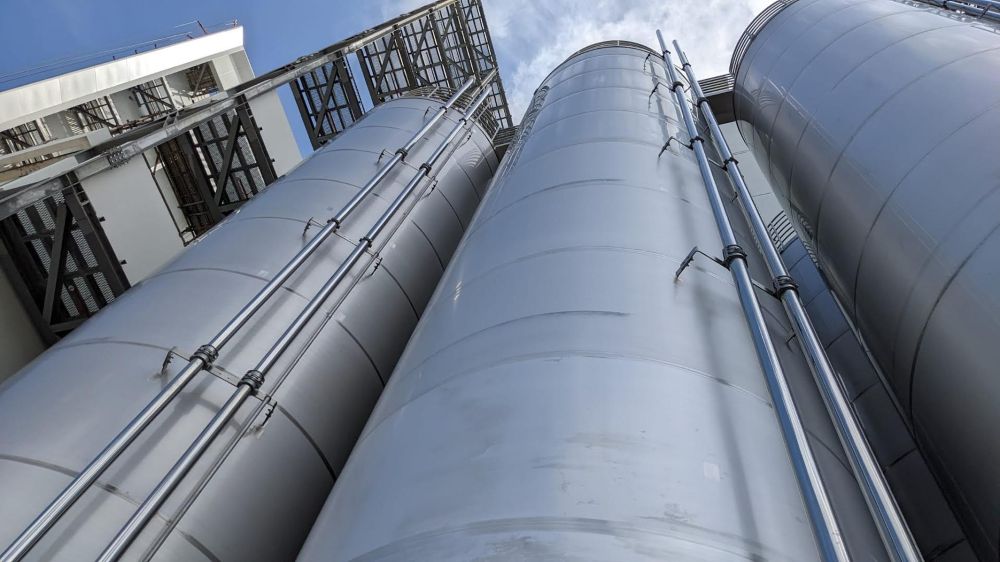
A silo is a vertical storage structure for the long-term storage of bulk raw materials, including powders such as sugar, flour, cocoa powder, and dairy products. Constructed from steel and typically positioned outdoors or along the plant perimeter, silos insulate their contents from moisture and contamination while meeting the stringent food safety requirements of industrial food-processing environments.
It’s worth noting that the conical base of a silo is a structural feature of the vessel itself, not a separate component.
Key benefits of a silo include:
- Supply Continuity: Storing days or weeks’ worth of raw material on-site reduces dependence on frequent deliveries, stabilising plant operations.
- Centralised Material Intake: A silo consolidates bulk powder handling at a single intake point, simplifying logistics and material flow across the facility.
- Downstream Integration: Silos feed directly into conveying systems, providing a consistent and controlled material supply to production lines.
What is a Day Bin?
A day bin is a short-term buffer storage vessel sized to hold several hours to one day of material usage. Positioned between the conveying system and process equipment, it decouples upstream conveying from downstream processing.
In bulk powder handling systems, conveying lines exceeding approximately 100 metres pose a significant operational risk. Longer runs require large, high-powered blowers that are expensive to purchase and maintain, and are more prone to line chokes and accelerated equipment wear caused by high product velocity. A day bin cuts the conveying line into shorter, more manageable runs, allowing smaller and more efficient blowers to operate on each segment while reducing the risk of chokes and material degradation.
A day bin also maintains production continuity when the silo is being refilled. In some facilities, day bins can replace silos entirely, subject to operator availability and throughput requirements.
Key features of a day bin include:
- Level Monitoring: High-, low-, and continuous-level sensors enable automatic refill triggers from the upstream conveying system.
- Production Continuity: A day bin maintains an uninterrupted supply to downstream hoppers and machines during silo refilling or conveying interruptions.
- Operational Flexibility: Where throughput and operator availability allow, a day bin can serve as the primary storage point, simplifying overall plant layout.
What is a Hopper?
A hopper is a receiving vessel designed to facilitate the downstream process, typically installed directly above mixers, blenders, or feeders. Unlike a silo, a hopper is not intended for bulk storage.
Its primary function is the weighing, dosing, metering, and controlled discharge of material into process equipment. Hoppers are also smaller in capacity, commonly mounted on load cells, and connected directly to process inlets.
Key benefits of a hopper include:
- Accurate Batching: Hoppers mounted on load cells deliver precise material quantities, ensuring each production batch meets recipe specifications.
- Controlled Discharge: Direct connection to mixers and blenders allows metered material flow, reducing waste and improving process consistency.
- Recipe Integrity: Precise dosing through a hopper supports consistent output quality across industrial food processing operations.
How They Work Together
In a well-designed bulk powder handling system, each component occupies a distinct functional layer:
Bulk Delivery → Silo → Conveying System → Day Bin → Hopper → Process
Raw material arrives and is stored in the silo. A conveying system transfers it to the Day Bin, which maintains a short-term buffer for downstream operations. The hopper then doses material directly into the mixer or blender at the point of use.
Each stage depends on the one before it. As such, removing a component, or misusing one in a role it was not designed for, creates operational risk that compounds downstream.
Common Misconceptions About Silos, Hoppers, and Day Bins
To avoid under-designed systems, take note of these inaccurate assumptions during project planning:
- “A hopper is just a small silo”: Incorrect. A hopper doses, weighs, and discharges material into process equipment. A silo stores bulk material. They are not interchangeable.
- “The cone at the base of a silo is a hopper”: Not in the functional sense. That conical base is a structural discharge feature of the silo vessel, not a standalone dosing or weighing component.
- “A silo is enough, and we don’t need a day bin”: Operationally risky. Without a Day Bin, production is vulnerable to downtime during silo refilling, and long conveying lines place unnecessary stress on blowers and equipment.
Which to Choose? Determining the Right Storage Solution
When selecting a storage solution for your bulk materials, consider the following factors:
- Frequency of Discharge: Consider how often materials need to be unloaded. Frequent or continuous discharge calls for a well-designed silo with appropriate outlet geometry and flow aids, supported by a day bin to maintain a steady downstream supply without interrupting operations.
- Material Characteristics: Knowing the characteristics of the material you are going to store is important, as some materials might not be compatible with storage components. For instance, powders, grains, or materials prone to sticking, clumping, or bridging may require specially designed hopper angles or flow aids.
- Labour and Automation: Evaluate how much manual intervention your process can tolerate. Systems incorporating silos, day bins, and hoppers integrate with automated conveyors, pneumatic lines, and packaging equipment, reducing labour dependency and improving operational efficiency.
- Capacity vs. Operational Needs: Balance storage capacity with the operational demands of your facility. A silo addresses bulk raw material storage, a day bin manages short-term production buffers, and a hopper ensures accurate dosing at the point of use. Each plays a distinct role, and the right configuration depends on your production volumes, line layout, and scheduling demands.
Consult the Storage Experts
Planning to incorporate a hopper, silo or day bin into your production system? Partner with Pneu Powders Systems to ensure optimal design and performance for your bulk powder handling equipment and industrial food processing equipment. Our team provides:
- Initial consultation and material flow analysis
- Detailed structural calculations and hopper angle optimisation
- Integration with conveyors, pneumatic systems, or packaging lines
- Guidance on maintenance, safety, and operational efficiency
Working with experts ensures your hopper, day bin or silo is safe, efficient, and tailored to your facility’s needs, providing a reliable long-term solution for bulk material storage and handling.
For more information about silos, check out our guide on the different considerations for silo design, grain bin and silo functions, and the various types of silos.

